






























We covered Asteroid through a web-story. Now, there is lot of excitement about this passerby in space. Interstellar comet 3I/ATLAS is making its closest approach this December. This third confirmed interstellar object (ISO) offers a unique window into exoplanetary systems. It provides astronomers with precious material to study, literally from beyond our Solar System. We all should celebrate this rare visitor from the depths of space.
Discovery History of an Interstellar Comet
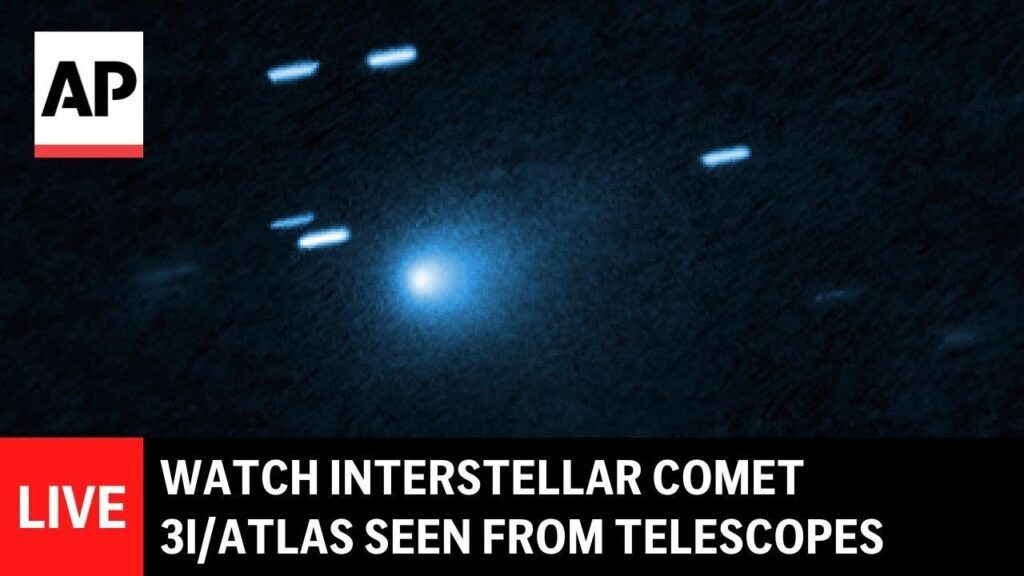
The discovery of this particular interstellar comet was quite recent. The ATLAS Telescope network first spotted it on July 1, 2025 at NASA. ATLAS stands for the Asteroid Terrestrial-impact Last Alert System. Astronomers quickly noticed its hyperbolic trajectory, which signaled an extraterrestrial origin. It was moving far too quickly to be gravitationally bound to our Sun. The object was officially designated 3I/ATLAS, confirming it as the third such traveler after 1I/’Oumuamua and 2I/Borisov. Finding this cosmic mystery was a huge win for continuous sky survey efforts globally.
🌌 How Far Away Is Our Interstellar Visitor?
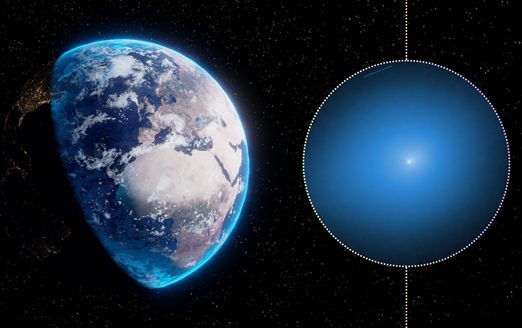
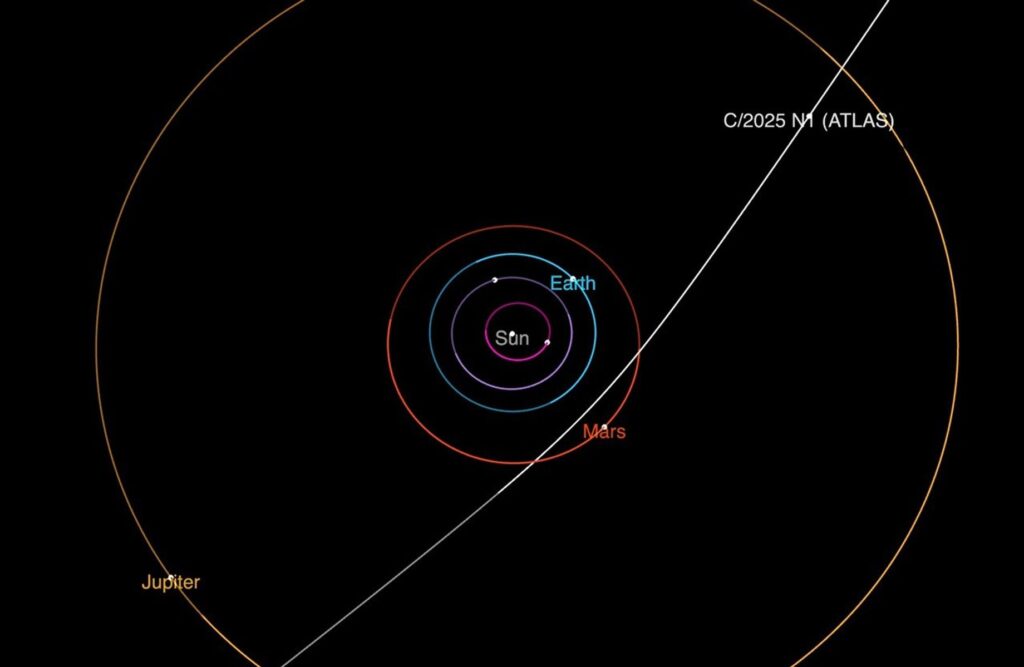
On December 19, 2025, the interstellar comet 3I/ATLAS will pass closest to Earth. Do not worry; we are perfectly safe from this Solar System visitor. The closest approach distance will be an enormous 269 million kilometers. This is roughly 1.8 times the entire distance between Earth and the Sun. The comet will actually be on the far side of the Sun relative to us. We can still track it using powerful instruments like the Hubble Space Telescope and James Webb Space Telescope (JWST). These instruments study its cometary composition and activity.
💥 Could an Interstellar Object Hit Earth?
The chances of this specific interstellar comet hitting Earth are zero. Its path is well-defined and monitored by planetary defense teams. However, what if a much larger interstellar object were on a collision course? An impact from a large comet would be truly devastating. A collision could trigger massive earthquakes and tsunamis.
Large impacts inject huge amounts of dust and debris into the stratosphere.
This dust blocks sunlight, causing a global drop in temperature, known as an impact winter.
Photosynthesis would fail, leading to the collapse of the food chain and global mass extinction.
Comets move much faster than asteroids, making their impact energy and potential destruction higher. Scientists are always studying deflection methods to prevent such catastrophic consequences.
💡 Fun Facts About 3I/ATLAS
This interstellar comet is full of surprises for scientists studying planetary formation.
It is incredibly old. Estimates suggest it formed potentially 3 to 14 billion years ago. This makes it possibly older than our own Solar System!
The chemical signatures are strange. Observations revealed unusually high amounts of carbon dioxide. The comet is also rich in nickel vapor compared to iron.
Some initial behaviors were anomalous. Harvard scientist Avi Loeb speculated about an alien artifact due to strange early light variations. Subsequent data confirmed it behaves like a unique comet.
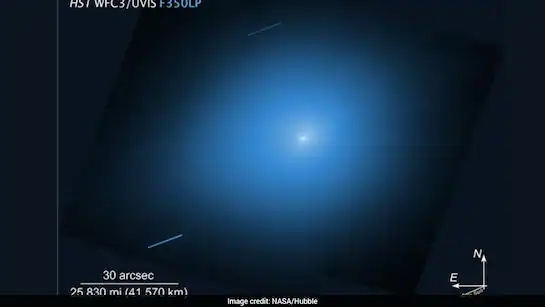
The comet briefly had an “anti-tail.” This dust plume was actually directed towards the Sun, which is the opposite of a typical tail!
FAQs About Interstellar Comet
Q: What is an interstellar comet and where does it come from?
A: An interstellar comet is an object traveling on a hyperbolic trajectory, meaning it originated outside our Solar System. It was likely flung out of its original exoplanetary system by a gravitational encounter.
Q: How is 3I/ATLAS different from 1I/’Oumuamua?
A: 1I/’Oumuamua was a darker, more asteroid-like interstellar object. Interstellar comet 3I/ATLAS shows clear outgassing and has a visible coma and tail, confirming its cometary nature.
Q: Is 3I/ATLAS dangerous to Earth?
A: No, it is not. Its closest approach on December 19, 2025, is 269 million kilometers away. This distance is completely safe.
Conclusion: Studying Comets from Other Star Systems
The journey of interstellar comet 3I/ATLAS offers an unparalleled opportunity. It is a messenger providing pristine material from other star systems. By studying its cosmic chemistry and velocity/speed, we learn about the vastness of the galaxy. We are expanding our understanding of exocomets and star system ejection. Keep following the news about this amazing interstellar comet.
#InterstellarComet #3IATLAS #SpaceMystery #ExoplanetarySystems #CosmicVisitor #ATLASDiscovery #InterstellarObject








Buraya tıklayarak inceleyin: Instagram Takipçi Satın Al
For informed buying decision visit – https://bestbuyingideas.com/
Buraya tıklayarak inceleyin: Youtube Takipçi Satın Al
For informed buying decision visit – https://bestbuyingideas.com/
Buraya tıklayarak inceleyin: Türk Takipçi Satın Al
For informed buying decision visit – https://bestbuyingideas.com/
Buraya tıklayarak inceleyin: Instagram Takipçi Satın Al
For informed buying decision visit – https://bestbuyingideas.com/
Buraya tıklayarak inceleyin: Ucuz Takipçi Satın Al
For informed buying decision visit – https://bestbuyingideas.com/
İncelemek için buraya tıklayın: Bitcoin Nasıl Alınır
For informed buying decisions, visit – https://topbuyingidea.com/
İncelemek için tıkla: En İyi Yabancı Diziler
İncelemek için tıkla: Aşk Kitapları
İncelemek için tıkla: Brawl Stars Elmas Hilesi
İncelemek için tıkla: Takipçi Hilesi
İncelemek için tıkla: En İyi Aksiyon Filmleri
İncelemek için tıkla: En İyi Aksiyon Filmleri
Satın almak için tıklayın: Tiktok Takipçi Satın Al
Başlatmak için tıklayın: Ücretsiz Takipçi
Başlatmak için tıklayın: İzlenme Hilesi
Başlatmak için tıklayın: Ücretsiz Beğeni
Başlatmak için tıklayın: Takipçi Hilesi
Başlatmak için tıklayın: Youtube Abone Hilesi
**mitolyn official**
Mitolyn is a carefully developed, plant-based formula created to help support metabolic efficiency and encourage healthy, lasting weight management.